The Usual Suspects Are Incomplete
Every rupee selloff gets the same explanation — crude, FPI outflows, and offshore NDF demand. But here is what nobody is talking about: the onshore corporate forward book is equally large, equally persistent.The market obsesses over NDF prints while a $75 billion long-dollar position rolls silently inside domestic corporate treasury books
The Bank Arbitrage Phase — And Why RBI Killed It
The first structural shock came from domestic banks as RBI saw banks becoming transmission belts for offshore speculation, blurring the line between offshore pressure and domestic price formation. The crackdown was swift. RBI banned the practice and also curbed rebooking of forwards to stop corporates from using hedging as a directional play. Though the rules eventually had to be moderated as the market pushed back on operational complexity.
The pipe was shut. But the demand didn’t disappear. It migrated — exactly as RBI feared — into corporate books.
Enter the Unknown Man: The Corporate Forward Book
While dealing rooms were focused on bank positions, NDF prints, and crude ticks, a slow-moving but enormous position was building in plain sight inside corporate treasury books across India Inc.
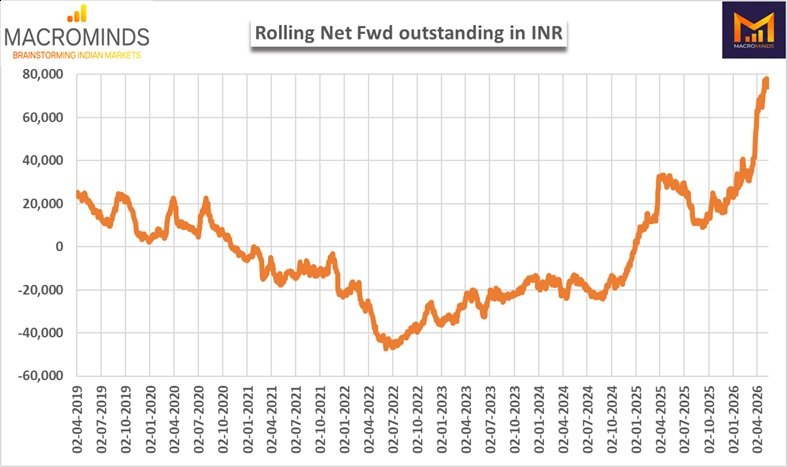
The corporate net forward position has flipped from net short USD ~$45 billion to net long USD ~$75 billion over the last four years — a swing of nearly $120 billion in aggregate positioning. The Unknown Man: $120 Billion Swing in Four Years
Between 2022 and 2026, the net corporate forward position flipped from net short USD ~$45 billion to net long USD ~$75 billion — a $120 billion swing. This is not hot money. This is importer CFOs, ECB borrowers, outbound investors, and select onshore FPIs rolling long-dollar forwards month after month. Patient, structural, sticky.
Several forces drove the flip simultaneously:
- Russia-Ukraine elevated commodity prices and rewired global supply chains; corporates locked in longer-tenor import cover for cost certainty
- US trade tensions and tariff risk made export revenue less predictable while import costs rose — importers moved faster than exporters
- Iran shock pushed every energy importer’s hedge ratio higher overnight
- INR managed depreciation (83→87) taught treasuries one lesson: when in doubt, buy the dollar forward
- Carry collapse — as forward premiums compressed, exporters lost incentive to sell receivables forward while importers kept buying, creating a structural asymmetry
- ODI uptick — as domestic investment opportunities narrowed, outbound capital deployment accelerated, adding natural non-speculative dollar demand
FPI onshore migration — post the NDF crackdown, select FPIs moved hedging onshore, adding quasi-offshore demand wearing domestic clothes
RBI as the Permanent Counterparty
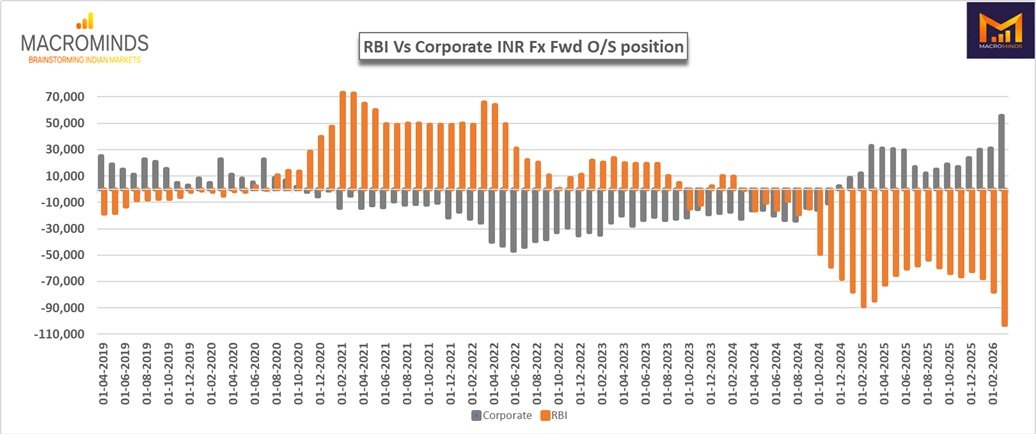
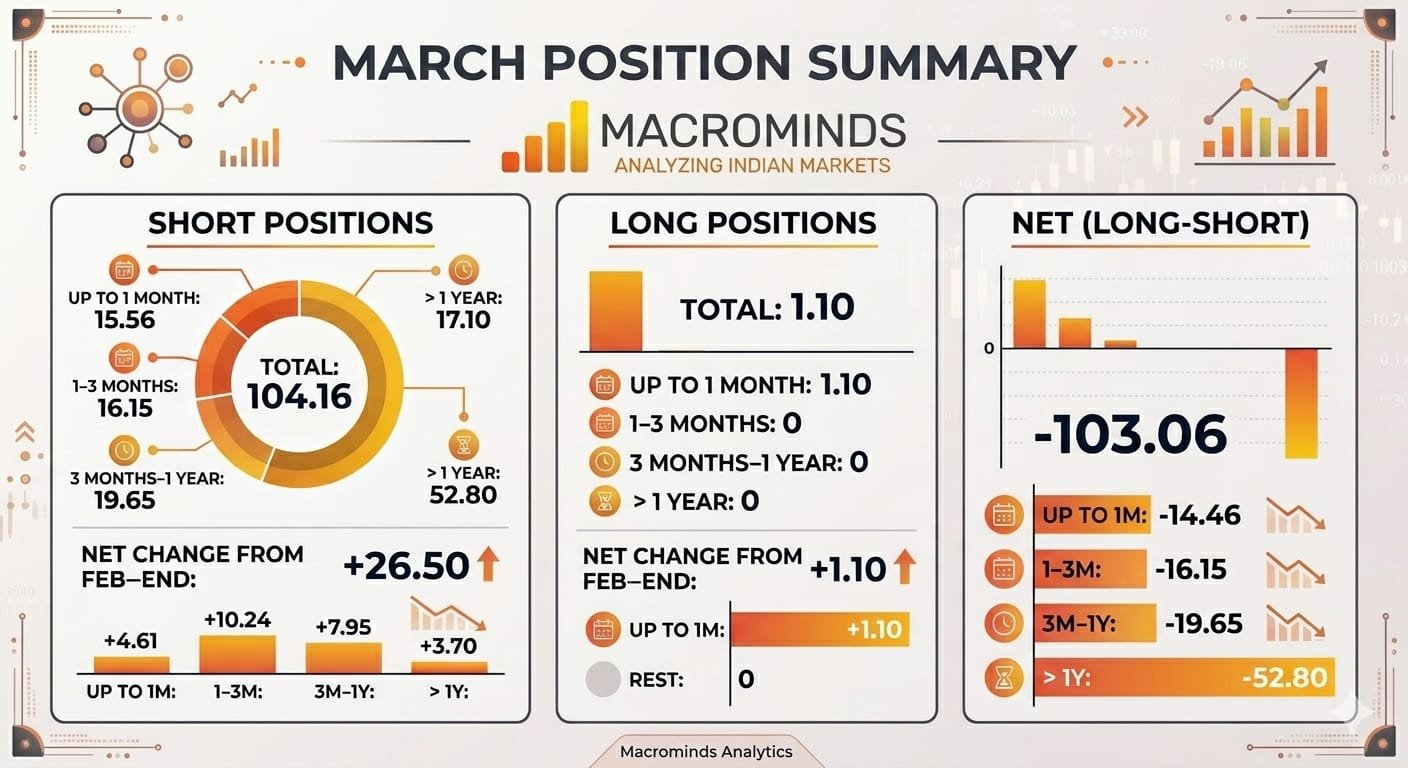
With corporates running long dollars at scale, someone had to take the other side. That someone was RBI. Quarter after quarter, the central bank absorbed net corporate demand by selling USD in the forward market. By February 2026, RBI’s net short dollar forward book reached $77 billion, then exploded to a record $104 billion in March 2026 — a 34% jump in a single month.
The benefits are real: INR is supported without burning spot reserves, rupee liquidity is managed through swap legs, and headline reserves stay intact for external optics. But the distortions are mounting:
- Self-fulfilling overhang — A $104 billion short forward book means $104 billion of future dollar demand is already pre-loaded. Markets anticipate RBI’s rollover buying and front-run it, making the problem recursive
- Corporate moral hazard — When the central bank is always the counterparty, corporate treasuries stop optimising. Hedge books are built for comfort, not conviction
- Shrinking intervention space — The larger the back-book, the less freedom in spot. A central bank with $104 billion of forward commitments cannot intervene aggressively in spot without compounding liquidity consequences
- Broken price discovery — With RBI permanently on one side, the forward curve is a managed construct, not a market price. Nobody knows where USD/INR actually clears in the central bank’s absence
The Mirror That Isn’t: Maturity Mismatch
The RBI and corporate books look like mirror images in aggregate. At tenor level, they are not:
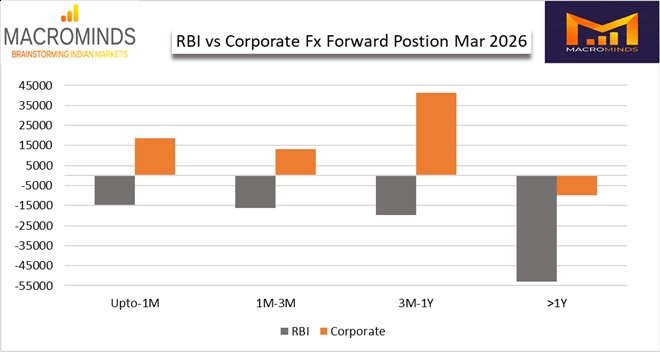
Corporate longs are concentrated in short-to-medium tenors. RBI’s biggest exposure is beyond one year at $52.8 billion — duration risk the corporate side is not carrying. The “mirror position” is true in headline stock, not in cash flow structure. Corporate rollovers create episodic short-end pressure at month and quarter-ends; RBI is sitting on a long-dated book that limits its flexibility precisely when it is most needed
Why This Matters for INR
Sentiment amplifies structure. With $75 billion of corporate longs already in the book, every negative headline gets mechanically amplified — treasuries top up, roll forward, hedge more. The BoP doesn’t need to worsen for USD/INR to move.
Hedging is too cheap. When forward premiums are compressed, everyone over-hedges. A repricing of the forward premium would force corporate treasuries to be selective and naturally deflate the overhang.
RBI is betting on BoP stability. By absorbing demand in forwards rather than letting spot clear, RBI is implicitly assuming India’s external balance holds. If that assumption is correct, the book unwinds cleanly. If the BoP worsens, $104 billion of deferred pressure becomes a very large maturity wall.
Conclusion
The INR story has always had a visible cast — crude, gold, FPIs, NDF. The unknown man never made the list. But for four years, while the market looked offshore, the domestic corporate forward book quietly built a $75 billion long-dollar position that now rivals the offshore complex in size and surpasses it in stickiness. RBI stepped in as the permanent counterparty, and in doing so, became both the market’s shock absorber and its most significant source of future risk. The forward book has bought time and managed volatility — but it has not resolved the underlying demand. Until the corporate overhang deflates — through a repricing of carry, a reversal in trade conditions, or a genuine BoP improvement — the unknown man remains in the room. And he is not leaving quietly.