Category: Market Insights

  • Desk Diary: The Day Fixed Income Traders Won’t Forget in a Hurry

    Desk Diary: The Day Fixed Income Traders Won’t Forget in a Hurry

    Some days you trade the market. Some days the market trades you. Today was the second kind.

    Let me just walk you through it, because honestly, by 4 PM half the desk had given up trying to predict what comes next.

    Morning: Gap Down, But We Held

    Opened to a mess. Crude ripping to $108 after the Houthis hit an East-West pipeline overnight, ECB hiking rates while we were enjoying our dinner, and our own calendar stacked — 36K cr SDL auction lined up for next week, a 26-day VRRR, and a 32K cr Gsec auction all in the mix.

    First blow landed early — the morning VRRR flopped. 60K cr subscribed against a 5 lakh cr offer. That’s not a soft bid, that’s the market basically saying “no thanks” to the RBI’s own liquidity withdrawal tool.

    And yet — credit where due — the market held its ground. Gap down, failed VRRR, ECB overnight, crude spiking… and we still crawled back to the day’s highs. For about an hour there, it genuinely felt like we might shrug the whole thing off.

    Then….

    Midday: One TV Byte, One Ugly Selloff

    RBI governor comes on TV, drops a line about having options beyond VRRR and CRR if needed. That’s it. That’s all it took.

    Market turned on a dime, sold straight down to day’s lows. 5-year got absolutely hammered — yields up 10 bps intraday. If you were sitting long duration into that comment, you felt it in your stomach before you felt it in your P&L.

    The Auction: RBI Blinked, or Did They?

    Then the 3-year cutoff came in and nobody on the desk had a clean explanation for it.

    11,000 cr on offer. Bids worth 23,263 cr came in — more than double covered. RBI accepts… 4,500 cr. At a cutoff lower than street expectations. They just left more than 18,000 cr of demand sitting on the table.

    Everyone’s asking the same question — are they not comfortable with where yields printed? Is this a message? Market took some comfort that they didn’t force paper through at a worse level, but nobody’s relaxed. We closed the day watching our backs.

    10Y ended at 7.02%, up 4 bps. 5Y at 6.66%, up 8 bps. Not a bloodbath, but a day that leaves a mark.

    After the Bell: Just When You Thought It Was Over

    Market shuts, everyone’s packing up, and RBI drops a 1 lakh cr OMO sale — 2029 to 2031 maturities. Which lines up almost exactly with the FCNR redemption window.

    Read that again. Same day the government couldn’t place 11K cr of the 3-year comfortably, RBI turns around and says it wants to pull out 1 lakh cr more from the system on the 17th. Make it make sense.

    Here’s how I’m reading it. RBI wanted to sterilise the surplus liquidity the easy way — soft VRRR, no drama, pull it out at its own pace without spooking anyone. But the market got smart about it, tried to play the RBI’s own hand back at them, angling for an exit on their terms instead of the RBI’s. That auction cutoff was the first sign they weren’t going to let that slide. The OMO sale after the bell was the punishment leg — RBI making sure the message landed and the sterilisation happened anyway, market’s comfort be damned. And there’s another way to read this too — maybe it’s not just about teaching the market a lesson, maybe they’re genuinely nervous about inflation and this is them blinking first. If that’s the real story, an October hike just started looking a lot more likely.

    And Then Washington Joined the Party

    As if we needed one more thing — US core CPI printed hot overnight. September hike odds for the Fed now sitting at 89%.

    Bottom Line

    Failed VRRR in the morning, RBI jawboning at noon, a cutoff that raised more questions than it answered, and an OMO sale dropped like a mic after the market went home. Add a hot US CPI print for garnish.

    Nothing about today got resolved. It just got more layered.

    Picture abhi baki hai. Let’s see what Monday brings.

  • RBI Buys Time with a $5 Billion FX Swap

    RBI Buys Time with a $5 Billion FX Swap

    RBI has signalled another round of “liquidity via FX” by announcing a fresh USD/INR FX swap of around USD 5 billion, effectively repeating the playbook it used through 2025–26 to inject durable rupee liquidity.

    What RBI has announced

    The central bank has announced that it will conduct a USD/INR FX swap auction of about USD 5 billion, where banks will deal dollars against rupees with RBI in a structured auction format.

    Operationally, that means banks sell dollars to RBI on the near leg (RBI injects rupee liquidity), and agree to buy those dollars back at a fixed forward premium on the far leg three years later, when RBI absorbs rupee liquidity.

    Quick explainer: how the FX swap works

    From RBI’s side this is a simple buy–sell swap designed for liquidity injection.
    On the auction date, RBI buys dollars at the reference rate, credits rupees into banks’ current accounts, and simultaneously sells the same dollars forward at a premium that banks bid for in the auction.

    So three things happen at once:

    • Auction spot (T+2): durable rupee liquidity in the banking system rises, and RBI’s FX reserves go up by USD 5 billion on the balance sheet.
    • Over the life: RBI carries a forward short dollar position – it has committed to deliver dollars back to banks at maturity – which it manages alongside its existing forward book.
    • At maturity: the swap reverses; banks pay back rupees plus premium, RBI returns the dollars, and that leg automatically drains rupee liquidity.

    Why RBI is doing this now

    With the West Asia conflict still live, the rupee has been printing fresh lows almost every month, and RBI has been leaning on FX intervention to slow the move. That defense has a twin impact: system liquidity tightens as RBI sells dollars spot, and the FX war‑chest shrinks as reserves decline from recent peaks.

    By running a three‑year buy–sell FX swap now, RBI is essentially doing two things at once: topping up its dollar stock and recycling rupee liquidity back into the banking system.It slows the pace of reserve depletion without abandoning its FX defence, and it supports funding conditions at a time when policy is trying to remain growth‑friendly despite global shocks.

    Does the current liquidity and FX backdrop justify this?

    On paper, injecting rupee liquidity in the middle of a depreciation phase – with USD/INR grinding higher into the mid‑90s – looks counter‑intuitive. But RBI has been clear that it wants durable liquidity around 1–1.5 percent of NDTL and has already used a mix of OMOs and FX swaps in late‑2025/early‑2026 to move from a deep LAF deficit towards that comfort zone.

    Liquidity has tightened meaningfully from the peak surplus seen in early April, helped by FX intervention, government cash balances and tax outflows, even as RBI tries to smooth things via daily VRR operations.

    VRRs only address frictional liquidity; they do not replace durable liquidity that supports term money, credit extension and rate‑cut transmission, which is why RBI is again reaching for the longer‑tenor FX swap.

    From a trader’s lens:

    • Liquidity: Call money and short‑end OIS have been flagging intermittent tightness despite prior OMOs and swaps; a three‑year FX swap is a clean way to inject longer‑duration liquidity without constantly rolling short‑term tools.
    • FX strategy: By building up a buy–sell swap book, RBI increases its ability to sell dollars spot later to manage the rupee, knowing that the far leg of the swap will automatically pull rupee liquidity out when it matures.
    • Regime consistency: Since early 2025, RBI has clearly preferred forwards and swaps to manage FX pressure – with repeated USD 5–10 billion operations – instead of large, one‑way spot interventions that immediately show up as big drops in headline reserves.

    In a textbook “currency under pressure” setup you would tighten rupee liquidity and sell dollars outright.
    In RBI’s current regime, the FX swap lets it ease rupee liquidity today, push some of the monetary tightening into the future at swap maturity, and still grow the stock of dollars it can deploy later in the spot market – that is the trade‑off it is consciously choosing.

    How the market is likely to trade this

    Forwards and basis

    Three‑year USD/INR forward premiums, which had been elevated on the back of RBI’s large forward short and onshore/offshore basis, should see some softening as RBI receives premium from the Street through this auction.

    Bonds and money markets

    A USD 5 billion buy–sell is roughly ₹48,000–50,000 crore of durable liquidity at current levels, which is meaningful when layered on top of OMOs and expected flows from the RBI dividend and government spending.

    That should be mildly supportive for T‑Bills and the short end of the curve; the high cut‑offs seen in recent bill auctions will be part of the backdrop that makes RBI more comfortable adding liquidity here.

    Spot USD/INR

    Headline reaction can be noisy – “RBI to buy USD 5bn” reads superficially INR‑negative in the very short term.

    But the broader signal is that RBI is doubling down on a managed‑float regime with ample intervention capacity; that usually caps intraday volatility even if the medium‑term trend for INR remains one of depreciation as long as the external deficit and FPI outflows stay in play.

    Conclusion

    Net‑net, the Street will read this as RBI prioritising transmission and funding stability over short‑term currency optics, while still keeping enough FX firepower to lean against disorderly INR moves.
    How much upside USD/INR still has from here will depend less on this one swap and more on whether oil, global yields and FPI flows stabilise – the swap just tells you RBI wants that adjustment to happen in an orderly, liquid market.

  • The Unknown Man in the INR Market

    The Unknown Man in the INR Market

    The Usual Suspects Are Incomplete

    Every rupee selloff gets the same explanation — crude, FPI outflows, and offshore NDF demand. But here is what nobody is talking about: the onshore corporate forward book is equally large, equally persistent.The market obsesses over NDF prints while a $75 billion long-dollar position rolls silently inside domestic corporate treasury books

    The Bank Arbitrage Phase — And Why RBI Killed It

    The first structural shock came from domestic banks as RBI saw  banks becoming transmission belts for offshore speculation, blurring the line between offshore pressure and domestic price formation.  The crackdown was swift. RBI banned the practice and also curbed rebooking of forwards to stop corporates from using hedging as a directional play. Though the rules eventually had to be moderated as the market pushed back on operational complexity.

    The pipe was shut. But the demand didn’t disappear. It migrated — exactly as RBI feared — into corporate books.

    Enter the Unknown Man: The Corporate Forward Book

    While dealing rooms were focused on bank positions, NDF prints, and crude ticks, a slow-moving but enormous position was building in plain sight inside corporate treasury books across India Inc.

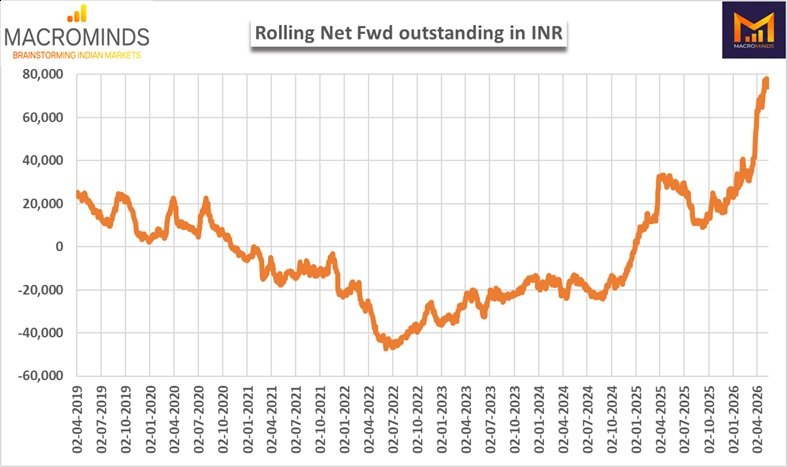
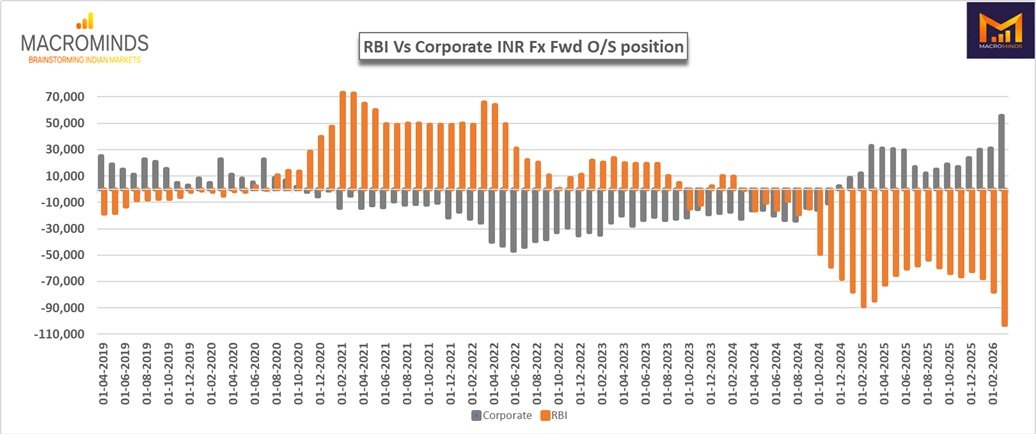
    The corporate net forward position has flipped from net short USD ~$45 billion to net long USD ~$75 billion over the last four years — a swing of nearly $120 billion in aggregate positioning. The Unknown Man: $120 Billion Swing in Four Years

    Between 2022 and 2026, the net corporate forward position flipped from net short USD ~$45 billion to net long USD ~$75 billion — a $120 billion swing. This is not hot money. This is importer CFOs, ECB borrowers, outbound investors, and select onshore FPIs rolling long-dollar forwards month after month. Patient, structural, sticky.

    Several forces drove the flip simultaneously:

    • Russia-Ukraine elevated commodity prices and rewired global supply chains; corporates locked in longer-tenor import cover for cost certainty
    • US trade tensions and tariff risk made export revenue less predictable while import costs rose — importers moved faster than exporters
    • Iran shock pushed every energy importer’s hedge ratio higher overnight
    • INR managed depreciation (83→87) taught treasuries one lesson: when in doubt, buy the dollar forward
    • Carry collapse — as forward premiums compressed, exporters lost incentive to sell receivables forward while importers kept buying, creating a structural asymmetry
    • ODI uptick — as domestic investment opportunities narrowed, outbound capital deployment accelerated, adding natural non-speculative dollar demand

    FPI onshore migration — post the NDF crackdown, select FPIs moved hedging onshore, adding quasi-offshore demand wearing domestic clothes

    RBI as the Permanent Counterparty

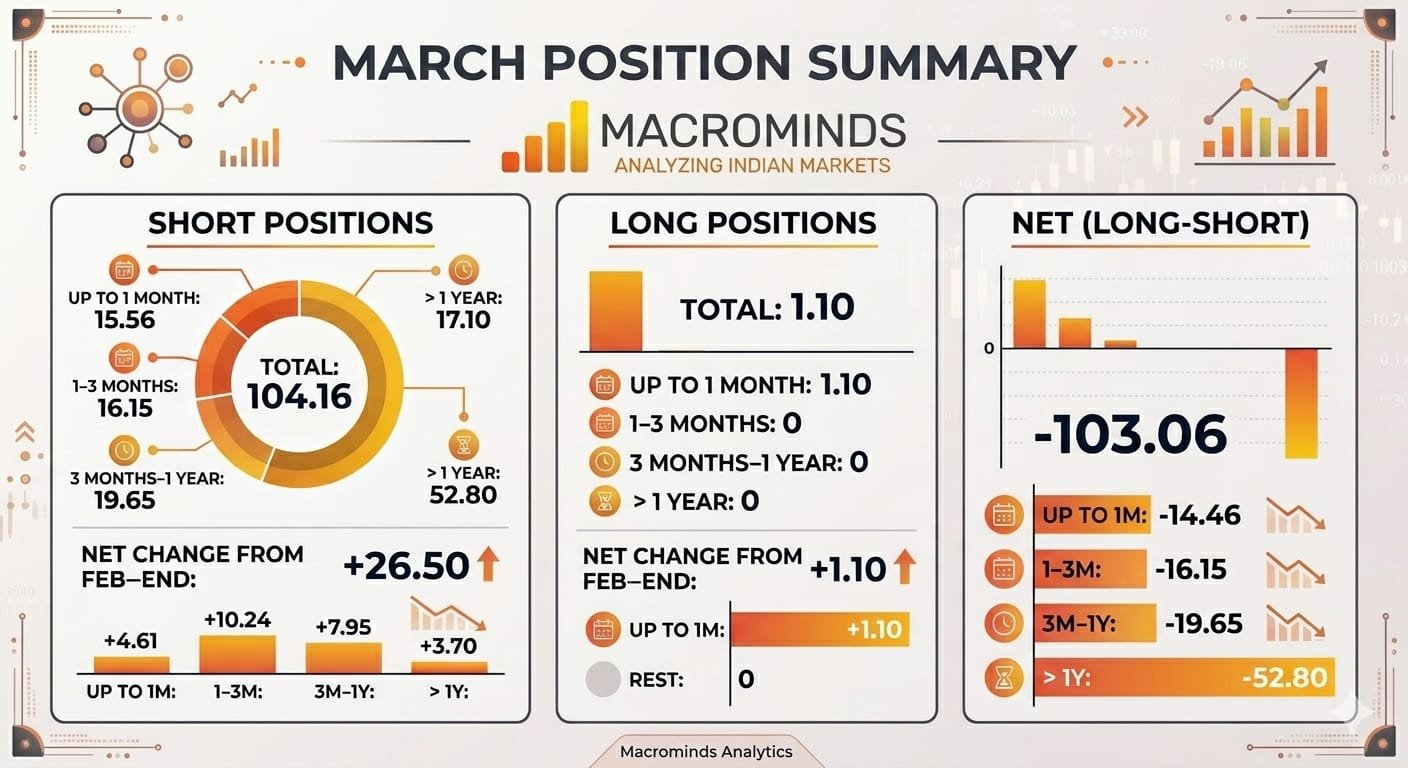
    With corporates running long dollars at scale, someone had to take the other side. That someone was RBI. Quarter after quarter, the central bank absorbed net corporate demand by selling USD in the forward market. By February 2026, RBI’s net short dollar forward book reached $77 billion, then exploded to a record $104 billion in March 2026 — a 34% jump in a single month.

    The benefits are real: INR is supported without burning spot reserves, rupee liquidity is managed through swap legs, and headline reserves stay intact for external optics. But the distortions are mounting:

    • Self-fulfilling overhang — A $104 billion short forward book means $104 billion of future dollar demand is already pre-loaded. Markets anticipate RBI’s rollover buying and front-run it, making the problem recursive
    • Corporate moral hazard — When the central bank is always the counterparty, corporate treasuries stop optimising. Hedge books are built for comfort, not conviction
    • Shrinking intervention space — The larger the back-book, the less freedom in spot. A central bank with $104 billion of forward commitments cannot intervene aggressively in spot without compounding liquidity consequences
    • Broken price discovery — With RBI permanently on one side, the forward curve is a managed construct, not a market price. Nobody knows where USD/INR actually clears in the central bank’s absence

    The Mirror That Isn’t: Maturity Mismatch

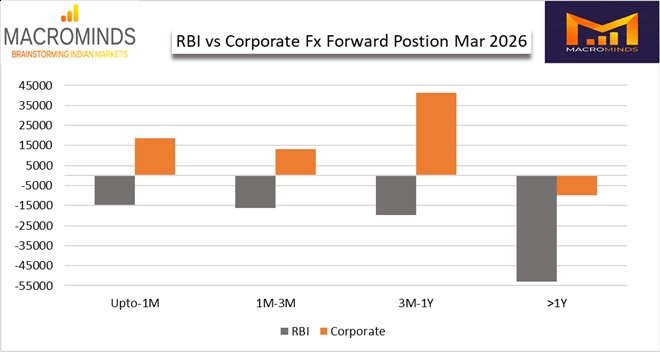
    The RBI and corporate books look like mirror images in aggregate. At tenor level, they are not:

    Corporate longs are concentrated in short-to-medium tenors. RBI’s biggest exposure is beyond one year at $52.8 billion — duration risk the corporate side is not carrying. The “mirror position” is true in headline stock, not in cash flow structure. Corporate rollovers create episodic short-end pressure at month and quarter-ends; RBI is sitting on a long-dated book that limits its flexibility precisely when it is most needed

    Why This Matters for INR

    Sentiment amplifies structure. With $75 billion of corporate longs already in the book, every negative headline gets mechanically amplified — treasuries top up, roll forward, hedge more. The BoP doesn’t need to worsen for USD/INR to move.

    Hedging is too cheap. When forward premiums are compressed, everyone over-hedges. A repricing of the forward premium would force corporate treasuries to be selective and naturally deflate the overhang.

    RBI is betting on BoP stability. By absorbing demand in forwards rather than letting spot clear, RBI is implicitly assuming India’s external balance holds. If that assumption is correct, the book unwinds cleanly. If the BoP worsens, $104 billion of deferred pressure becomes a very large maturity wall.

    Conclusion

    The INR story has always had a visible cast — crude, gold, FPIs, NDF. The unknown man never made the list. But for four years, while the market looked offshore, the domestic corporate forward book quietly built a $75 billion long-dollar position that now rivals the offshore complex in size and surpasses it in stickiness. RBI stepped in as the permanent counterparty, and in doing so, became both the market’s shock absorber and its most significant source of future risk. The forward book has bought time and managed volatility — but it has not resolved the underlying demand. Until the corporate overhang deflates — through a repricing of carry, a reversal in trade conditions, or a genuine BoP improvement — the unknown man remains in the room. And he is not leaving quietly.

  • RBI’s Forward Short Book: Why the Market Is Paying Attention

    RBI’s Forward Short Book: Why the Market Is Paying Attention

    RBI’s short forward book crossing the $103 billion mark is a big number, but the real story is in why it has grown so fast. The answer is straightforward: the rupee has been under pressure from multiple directions—oil‑shock risk linked to the Iran conflict, persistent FPI outflows, and a weaker external‑balance outlook. This is not a one‑off shock; it is a sustained drag on the currency.

    The market is not viewing this as a routine intervention cycle. It looks more like RBI has been forced to lean heavily on forwards to slow the pace of depreciation while trying to avoid repeated spot sales that rapidly erode headline reserves. That can work for a while, but the larger the forward short book becomes, the more the market starts to question how sustainable this stance really is.

    Why RBI is using forwards

    The logic is simple: when the rupee weakens, RBI can sell dollars in the spot market, but repeated spot operations directly reduce disclosed reserves and can send an uncomfortable signal. Forward intervention gives the central bank another lever—it provides near‑term FX support without the same immediate reserve depletion seen in spot sales. That is why central banks often rely on forwards and swaps when their goal is to smooth volatility rather than defend a fixed exchange rate.

    Beyond this general reason, there is another important dynamic at play. The scale of RBI’s forward‑dollar selling appears to be significantly larger than what would be justified by the expected current‑account deficit for the year. Even at a crude price of around $100, many estimates suggest the external deficit can be capped at roughly $80 billion. Yet RBI’s actions suggest dollar demand is running well beyond that figure.

    This points to heavy buying from importers—hedging higher oil and energy bills—as well as sizable speculative positioning in forwards. To counter this one‑way flow, RBI is effectively taking the other side of the market. Whether that timing turns out to be right or not, only time will tell. But the market is watching closely, because that kind of positioning concentrates risk in the central bank’s books.

    Market impact

    A large short forward book affects the market in several ways. First, it can support the rupee in the near term because it signals strong official dollar supply, which tends to discourage aggressive shorting. Second, it can flatten or distort forward points and short‑end pricing. When participants expect RBI to keep stepping in, they start discounting that intervention, and pricing can become less “clean” and more regime‑driven.

    Third, it creates concerns about future rollover pressure. If the book keeps growing, the market will increasingly focus on reserve adequacy, rollover risk, and whether RBI’s actions are delaying the move rather than changing the underlying FX trend. For the time being, the data reflect March numbers and the market was already pricing in the broad range of these flows, so there is no immediate shock. But the questions will only get sharper as the book expands.

    Conclusion

    The takeaway for traders and investors is clear: RBI’s $100 billion‑plus forward short position is not just a technicality; it is a signal of how hard the central bank is working to manage rupee pressure in a tough external environment. The scale of selling relative to the expected BoP deficit suggests that a lot of the demand is not just fundamental trade‑related hedging, but also speculative and front‑running flows.

    In this setup, RBI is effectively absorbing the brunt of the market’s dollar buying, but every dollar sold in forwards is a future liability that will have to be rolled, unwound, or settled. The market will now be watching whether the external backdrop improves, or whether RBI’s forward book becomes the main source of FX risk itself. The rupee’s path from here will depend less on pure fundamentals and more on the central bank’s patience, timing, and its ability to manage expectations as the book grows.