Some days you trade the market. Some days the market trades you. Today was the second kind.
Let me just walk you through it, because honestly, by 4 PM half the desk had given up trying to predict what comes next.
Morning: Gap Down, But We Held
Opened to a mess. Crude ripping to $108 after the Houthis hit an East-West pipeline overnight, ECB hiking rates while we were enjoying our dinner, and our own calendar stacked — 36K cr SDL auction lined up for next week, a 26-day VRRR, and a 32K cr Gsec auction all in the mix.
First blow landed early — the morning VRRR flopped. 60K cr subscribed against a 5 lakh cr offer. That’s not a soft bid, that’s the market basically saying “no thanks” to the RBI’s own liquidity withdrawal tool.
And yet — credit where due — the market held its ground. Gap down, failed VRRR, ECB overnight, crude spiking… and we still crawled back to the day’s highs. For about an hour there, it genuinely felt like we might shrug the whole thing off.
Then….
Midday: One TV Byte, One Ugly Selloff
RBI governor comes on TV, drops a line about having options beyond VRRR and CRR if needed. That’s it. That’s all it took.
Market turned on a dime, sold straight down to day’s lows. 5-year got absolutely hammered — yields up 10 bps intraday. If you were sitting long duration into that comment, you felt it in your stomach before you felt it in your P&L.
The Auction: RBI Blinked, or Did They?
Then the 3-year cutoff came in and nobody on the desk had a clean explanation for it.
11,000 cr on offer. Bids worth 23,263 cr came in — more than double covered. RBI accepts… 4,500 cr. At a cutoff lower than street expectations. They just left more than 18,000 cr of demand sitting on the table.
Everyone’s asking the same question — are they not comfortable with where yields printed? Is this a message? Market took some comfort that they didn’t force paper through at a worse level, but nobody’s relaxed. We closed the day watching our backs.
10Y ended at 7.02%, up 4 bps. 5Y at 6.66%, up 8 bps. Not a bloodbath, but a day that leaves a mark.
After the Bell: Just When You Thought It Was Over
Market shuts, everyone’s packing up, and RBI drops a 1 lakh cr OMO sale — 2029 to 2031 maturities. Which lines up almost exactly with the FCNR redemption window.
Read that again. Same day the government couldn’t place 11K cr of the 3-year comfortably, RBI turns around and says it wants to pull out 1 lakh cr more from the system on the 17th. Make it make sense.
Here’s how I’m reading it. RBI wanted to sterilise the surplus liquidity the easy way — soft VRRR, no drama, pull it out at its own pace without spooking anyone. But the market got smart about it, tried to play the RBI’s own hand back at them, angling for an exit on their terms instead of the RBI’s. That auction cutoff was the first sign they weren’t going to let that slide. The OMO sale after the bell was the punishment leg — RBI making sure the message landed and the sterilisation happened anyway, market’s comfort be damned. And there’s another way to read this too — maybe it’s not just about teaching the market a lesson, maybe they’re genuinely nervous about inflation and this is them blinking first. If that’s the real story, an October hike just started looking a lot more likely.
And Then Washington Joined the Party
As if we needed one more thing — US core CPI printed hot overnight. September hike odds for the Fed now sitting at 89%.
Bottom Line
Failed VRRR in the morning, RBI jawboning at noon, a cutoff that raised more questions than it answered, and an OMO sale dropped like a mic after the market went home. Add a hot US CPI print for garnish.
Nothing about today got resolved. It just got more layered.
Picture abhi baki hai. Let’s see what Monday brings.
Every good magic trick has a moment where the audience forgets to ask “wait, how?” This is that question, answered.
The Set-Up
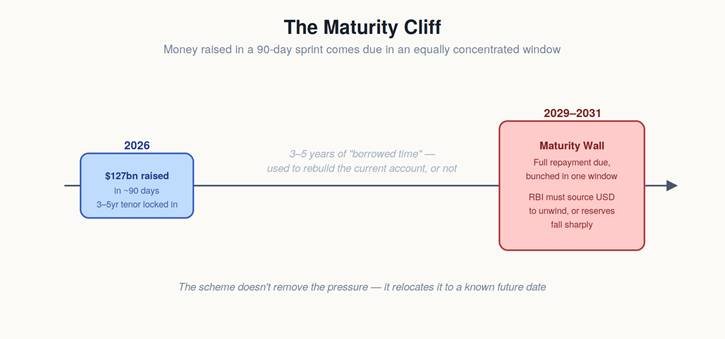
Picture the scene: it’s 2026, the rupee is under pressure, and somewhere in Mumbai a trader watches $127 billion land on India’s shores in about ninety days. Not from exporters. Not from foreign companies building factories. From non-resident Indians, suddenly falling over themselves to park dollars in Indian bank deposits.
The headlines write themselves: reserves surge, rupee steadies, India shows its resilience. Cue applause.
Except — ask yourself the question nobody in that headline bothered to ask: why would anyone suddenly want to lend India dollars at exactly the moment everyone else is nervous about India?
The honest answer isn’t confidence. It’s pricing. Somebody made it worth their while — and that somebody was the Reserve Bank of India, quietly picking up a tab that doesn’t show up in any press release.
This is the story of how that tab got run up, who’s actually paying it, and why the bill comes due on a very specific date whether anyone’s ready for it or not.
1. The Trick, Explained
Every trick has a mechanism. Here’s this one, in the order the money actually moves.
An NRI in Dubai, London, or Singapore parks dollars in an Indian bank — an FCNR(B) deposit, locked in for 3 to 5 years. They get a coupon nudging 6–7% in dollar terms. For context, that’s rich enough to make a US Treasury investor blink. And critically: the depositor takes zero currency risk. Whatever the rupee does over the next five years, they get dollars back at maturity. It’s a genuinely great deal — for them.
(There’s a leveraged version of this deposit too, where banks gear up exposure further. That’s a rabbit hole for another day — worth flagging, not worth derailing this story.)
So who’s paying for “genuinely great”? Follow the money one more step.
The bank holding that deposit doesn’t want dollar risk either. So it walks straight to RBI and does a swap: sells RBI the dollars today, gets rupees back, and signs up to reverse the whole thing — buy the dollars back — on the day the NRI deposit matures. Two legs: spot today, forward later. Textbook currency hedge.
Except it isn’t priced like a textbook hedge. A hedge like this, priced honestly by the market, would cost the bank something in the region of 3–3.5% a year — that’s simply what covered interest parity says a multi-year dollar hedge should cost when Indian rates sit well above US rates. That’s real money, and normally it’s the bank’s problem, which they’d either eat (thin margins) or pass on to the depositor (lower dollar yield, less enticing deposit, fewer dollars mobilized).
RBI removes that cost. It offers the swap at a fixed, concessional rate — in practice, close to free. And that’s the entire trick. Once the hedge is nearly free, the bank can afford to offer NRIs a rich 6–7% coupon and still walk away with a healthy margin. The “attractive NRI deposit rate” that pulled in $127 billion wasn’t the market discovering India was suddenly a better bet. It was RBI quietly picking up the hedging bill so the numbers would work.
One more wrinkle worth knowing: the swap only covers the principal, not the interest. So even in this “free hedge” story, banks are still carrying a real cost nobody’s giving them a concession on.
2. Three Balance Sheets, Three Different Stories
Here’s where the trick gets interesting — because “free” money never actually vanishes. It just moves to a different balance sheet, and each one tells its own version of the story.
The Country’s Story: A Bigger House, More Debt
India’s official reserves went up. Import cover — reserves divided by monthly imports — looks stronger. Every headline number improved.
But zoom out: FCNR(B) deposits are external debt. They count, in full, against India’s gross external liabilities. And India’s Net International Investment Position — the difference between what India owns abroad and what it owes — was already sitting at roughly –$210 billion as of March 2026. This scheme didn’t fix that number. It just changed what kind of liability sits on the other side of the ledger, and shortened the average maturity of that liability into a 3–5 year bullet.
Think of it like refinancing your mortgage into a bigger, shorter-term loan and celebrating that your bank balance looks fuller this month.
RBI’s Story: Long Cash, Short a Promise
RBI now holds a pile of dollars (the spot leg) and an equal, offsetting promise to hand them back later (the forward leg). Net currency risk today: essentially zero — the two legs cancel out.
But “zero risk today” isn’t the same as “zero cost.” Normally, when RBI moves from a rupee asset into a lower-yielding dollar asset, the market pays RBI a premium to compensate — that’s just how the yield gap gets priced. This time, RBI gave that forward away at effectively zero cost. It’s the mirror image of the bank’s story: the bank saved money on its hedge; RBI is the reason the money got saved, and RBI’s own income statement is what absorbed the difference.
That’s not a scandal. It’s a subsidy. It just doesn’t get called one out loud, because it never shows up as a line item in a government budget — it just quietly shows up later as a smaller-than-otherwise RBI surplus transfer to the Treasury.
The Banks’ Story: The Best Trade on the Desk
For the banks, this is about as good as it gets. Currency risk: hedged away entirely. Reserve requirements: waived on the incremental deposits (CRR/SLR exemptions). Margin: the gap between what they earn deploying the rupee proceeds and what they pay the NRI, virtually risk-free.
If you’re a trader reading this and thinking “that’s a trade I’d want on,” you’re seeing exactly why $127 billion showed up in ninety days. It wasn’t diaspora sentiment. It was a well-priced trade, and the market took it.
3. Debunking the Coffee-Shop Version of This Story
Every big market event grows its own folklore. Here’s what people say, and what the balance sheet actually says back.
“RBI isn’t subsidizing anything.” It is. The gap between the market’s honest 3–3.5% hedging cost and RBI’s near-zero concessional rate is a real, quantifiable cost — it just gets paid quietly, through a smaller RBI surplus, rather than loudly, through a budget line.
“RBI must be printing money on this if the rupee strengthens.” No — this is a swap, not a bet. RBI is long spot dollars, short a forward. If the rupee strengthens, RBI gains on the forward leg, but the counterparty bank is the one left worse off — RBI isn’t pocketing some independent windfall on top. The two legs are designed to net out, not to generate upside.
“RBI is sitting on huge currency risk” / “RBI has zero risk, full stop.” Both overstate it. There’s no open currency exposure while the swap structure stays in place — the two legs cancel. The risk shows up later, and only if RBI actually starts selling down the dollars it accumulated this way. Right now, it’s a matched book. The clock just hasn’t started yet.
“NRIs are the only ones making money here.” Actually three parties are splitting the pie — NRIs get a rich coupon, banks get a fat, low-risk margin, and RBI is the one funding the difference. Take away RBI’s subsidy and this whole structure looks a lot less generous to everyone in the chain.
“This is just India’s growth story finally getting recognized.” If that were true, why did $127 billion show up in ninety days instead of trickling in over years? Money that fast, that concentrated, is chasing a price, not a story. The story helps at the margin. The concessional swap is what actually moved the needle.
“These are now permanent reserves — India’s safety net just got bigger.” Every dollar of it has an expiry date. It’s borrowed, not earned, and the loan comes due in 3–5 years, in full, on a specific calendar date RBI already knows.
“This is basically the same as foreign investment (FDI/FPI) coming in.” Not even close. FDI doesn’t come with a repayment date. FPI is volatile but not centrally subsidized. This is neither — it’s closer to a central-bank-guaranteed loan to the banking system, dressed up in the language of a deposit inflow.
4. The Hangover: Where Does All That Rupee Liquidity Go?
Here’s the part most headlines skip entirely. Every dollar RBI buys spot, it pays for in freshly created rupees. That’s not a footnote — that’s potentially inflationary, rate-distorting liquidity flooding the banking system, and RBI has to mop it up somehow. It has five mops, and none of them are free:
VRRR (short-term borrowing from banks): Quick, flexible, reversible — and basically useless against a multi-year problem. Banks have even been reluctant to lock money up for more than a few days, forcing RBI to sweeten the deal with premature-withdrawal options.
MSS/CMBs (government paper that locks liquidity away): Can absorb real scale, but needs the government and RBI rowing in the same direction, adds to the government’s own debt stock, and carries a genuine fiscal cost.
OMO sales (RBI selling bonds outright): Works, but it means more bond supply hitting the market — which pushes sovereign yields up. Somewhere, a bond desk is feeling this.
CRR hikes (forcing banks to park more with RBI, unpaid): Blunt, effective, and more than a little ironic — the same banks just got a CRR exemption to go mobilize these deposits, and now might get hit with a CRR hike to clean up after themselves.
RBI’s own sell/buy swaps: Kicks the liquidity problem further down the road rather than solving it — and if the underlying currency pressure hasn’t actually eased by then, RBI may still need real dollars in hand when that day comes.
The honest summary: there is no clean-up option here that doesn’t cost someone, somewhere — bondholders, banks, or the fiscal account. Defending a currency is never actually free. It just moves the bill to wherever it’s least visible.
5. The Clock Is Already Ticking
Here’s the part that should actually keep a trader up at night, more than anything above.
Every FCNR(B) deposit raised today has a maturity date already fixed. Three to five years from now, a wall of dollars comes due, all clustered around the same window — because they were all raised in the same few-month sprint. If, on that date, RBI can’t easily source fresh dollars to refinance the unwind, reserves take a sharp, sudden hit — precisely the kind of event this whole scheme was supposed to prevent.
And here’s the twist that makes 2026 sharper than 2013: the forward premium right now is already sitting above the actual interest rate gap between India and the US. In plain terms — an investor can run the swap math today and effectively earn something like 7.5% parked in US Treasuries, against roughly 6.5% available onshore in India. That’s not a rounding error. That’s a standing invitation for capital to walk straight back out, and it can happen even while headline reserves look perfectly healthy — because this isn’t a confidence problem, it’s a pricing problem, and pricing problems don’t wait for a crisis to resolve themselves.
Layer on soft domestic growth and rich asset valuations, and you have the ingredients for outflows that continue quietly in the background, reserve cushion or not.
This is the real lesson: a reserve number padded with borrowed dollars looks identical to a reserve number backed by earned ones — right up until the moment it doesn’t. Borrowed reserves work fine against an ordinary, expected outflow. They are far less useful against a genuine speculative attack, or against import-hedging demand for dollars running hotter than anyone modeled.
6. So What Is This, Really?
Strip away the applause and the anxiety both, and FCNR(B) is exactly one thing: a tactical bridge, not a foundation. It buys time — time to let volatility settle, time for the current account to adjust, time to signal that the central bank isn’t asleep at the wheel. That’s a genuinely useful thing for a central bank to be able to do.
What it can’t do is manufacture a stronger external balance sheet out of thin air. The real fix — a narrower current account gap, durable FDI, export competitiveness, deeper organic capital flows — doesn’t come from a clever swap. It comes from the slow, unglamorous work that no headline ever gets excited about.
There’s a sharper policy point hiding in here too: maybe the answer isn’t more concessional windows every time the currency wobbles. Maybe some currency depreciation — the kind driven by hedging flows and rate differentials rather than a genuine balance-of-payments problem — should just be allowed to happen, rather than administratively papered over every single time. Every version of this scheme, in every era it’s been deployed, has ended the same way: with a fresh round of “so what happens when it all matures” questions. That’s not bad luck. That’s the design.
7. The Questions Nobody’s Answering Out Loud
Push past the myths and the mechanics, and three genuinely uncomfortable questions remain — the kind that don’t have a clean official answer, and probably won’t get one.
Why go through the banks at all? If a roughly 3% forward premium was sitting there in the open market, RBI could, in theory, have just transacted that swap directly at scale, letting the market’s own pricing do the work — instead of running a bespoke, bank-intermediated version of the same trade at a discount. Why the middleman?
Why not just let the sovereign borrow directly? The government could have issued a dollar bond of its own and paired it with a swap against RBI — raised at the sovereign’s actual credit spread, no embedded subsidy required. Instead, the whole structure runs through bank balance sheets. Nobody’s explained why that channel won.
If the arbitrage is real, what stops it leaking straight into US Treasuries? If the forward premium genuinely sits above the covered rate differential, that’s a textbook arbitrage signal — and arbitrage gets arbitraged. What’s actually stopping banks from taking their now-cheaply-hedged dollars and quietly parking them in Treasuries instead of the Indian economy the scheme was built to support?
Nobody’s answered any of these publicly. And that silence is its own kind of answer: it suggests this scheme was built for speed and headline optics, not for the cleanest possible pricing of the risk everyone downstream is now holding.
This is an analytical explainer for market practitioners, not investment or trading advice. Figures cited for the 2026 window ($127bn inflow, NIIP of –$210bn as of March 2026, 6–7% USD coupons, 3–3.5% forward premium) reflect that specific episode; the original 2013 scheme (~3.5% all-in concessional cost) was calibrated differently while running on the same underlying mechanics.